|
Radical inventions
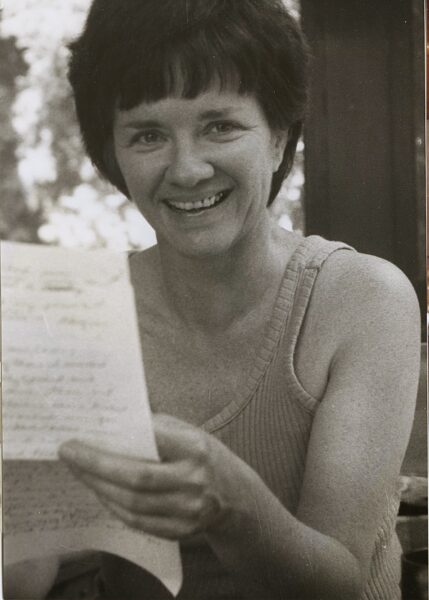
Monique Wittig, 1935-2003
“But remember. Make an effort to remember. Or, failing that,
invent.’ Monique Wittig, Les Guerilleres
Monique Wittig, who has died aged 67, was one of the most provocative and
innovative of lesbian feminist thinkers of the twentieth century. Wittig was
born in Dannemarie, on the Upper Rhine in France on 13 July 1935. After a
country childhood, Wittig moved with her family to Paris, where she attended
university and worked in publishing. She received her doctorate from the ƒcole
des Hautes ƒtudes en Sciences Sociales in Paris. Wittig met her lifelong partner
Sande Zeig in Paris in 1975, while both were becoming involved in the French
women’s liberation movement. She moved to the United States in the mid-1970s and
held a number of teaching positions in different institutions, including the
University of California at Berkeley, New York University, Duke University and
Vassar College. At the time of her death she was Professor of French and Women’s
Studies at the University of Arizona.
It is impossible, viewing the range of her output from the 1960s up to the
FInal projects she was working on at the time of her death (including a
screenplay based on life at the Mexican border), to categorize or delimit
Wittig’s work as either principally literary or theoretical; indeed the
distinctions between these forms were always problematic to Wittig. Her writings
include novels, short stories, plays, theory and criticism, yet in each of these
genres her attempt was always to test the generic boundaries, pushing them so
hard at times that they shattered, allowing new possibilities of form and
representation to emerge. For Wittig, the existing languages of patriarchal
culture were the enemy of both women and men, concretizing a system of
oppression and “slavery’ in which women, and other Others, become both commodity
and fetish.
For Wittig the attack on patriarchal language meant being a practitioner as
well as a theorist. Her literary experimentation is perhaps best represented by
the Five works of Fiction she produced between 1964 and 1985: L’Opoponax, 1964
(published in English in 1966), for which she won the Prix Medicis; Guerilleres,
1969 (translated in 1971); Le Corps lesbien, 1973 (in English, 1975); the
coauthored Brouillon pour un dictionnaire des Amantes, 1975 (Lesbian Peoples:
Material for a Dictionary, 1979); and Virgile, non, 1985 (Across the Acheron,
1987). Literature, for Wittig, was a discourse with political power and
potential. “Any important literary work’, she wrote, “is like the Trojan Horse
at the time it is produced.’
Wittig’s second novel, Les Guerilleres, is one such “war machine’.
Envisioning a future time of conflict between the sexes, the women of the text
wage war on the language and the bodies of men. This physical assault in the
novel is mirrored in the text’s assaults on linguistic and literary traditions.
Opening with the suggestive imagining of a space beyond patriarchal culture,
the text begins with the words “Golden Spaces Lacunae’, previsioning the textual
gaps and lacunae that structure the innovative, experimental form of the novel.
Throughout the novel remains typographically and structurally rebellious; some
pages contain only capitalized paragraphs and others present large gaps between
paragraphs to signal breaks in action and sense. At points the text of Les
Guerilleres is punctuated by pages printed only with a large black circle. This
circle, the text tells us, evokes “the vulval ring’, welding the body to textual
representation and at the same time defying normative (and inherently
patriarchal) linguistic forms and regulations of representation.
For Wittig, however, the move to deconstruct language must also be
supplemented by a move towards reconstruction. In one attempt at this project
Wittig, along with Zeig, produced the Fictional Lesbian Peoples: Materials for a
Dictionary (1979). Laid out in dictionary form, it takes existing words and
recasts their meaning and intonation. Wittig and Zeig demonstrate the role of
language in the construction of social “reality’ by reinscribing words to create
a world of solely female habitation in which history and myth are rebuilt and
refocused. In this “new’ language, women are situated at the heart of an
alternative culture.
The subtleties and complexities of Wittig’s literary experiments with
language and form are often lost in the movements of translation from (gendered)
French to (ungendered) English. In Les Guerilleres, Wittig uses “elles dissent’
when imagining her warrior race. Though this is translated into English as “the
women says’, Wittig’s intention here is to undermine the traditional parameters
of the universal subject position - that is to say, the male subject position.
In Le Corps lesbien, the speaking subject of the text is inscribed as J/e.
Wittig’s aim here is to do violent damage to the subject position accorded to
the Figure of the lover in the Western tradition of love poetry; such a position
has traditionally been ascribed to the male lover. How does a female lover
inscribe both her desire for a female love object and her identity as a female
lover of women? Writing the preface to the text Wittig stakes her claim for this
position, assertively taking it up and registering difference at the same time
in her splitting je into j e since the former “conceals the sexual difference of
the verbal persons’. By contrast j/e “poses the ideological and historical
question of feminine subjects’.
The battle over language was, for Wittig, necessarily violent, since the
dominant languages of culture exerted their own violent control over
subjectivity. It was a battle that required theorization as well as
explication and the radical potential of Wittig’s theoretical formulations
is perhaps evidenced most fully in the way in which her ideas provided pivotal
starting points for the emergence of queer theory. In her then
ground-breaking book Gender Trouble, Judith Butler undertakes a full
examination of Wittig’s pronouncements on language, lesbian identity and the
oppression of women. Butler, though ultimately critical of Wittig’s evocation of
the lesbian as a coherent, unitary identity, nevertheless uses an exploration of
the body of Wittig’s work to develop her own theoretical mapping of the
relationship between societal “realities’, cultural fIelds and the “fIctions’ of
gender identity. In particular, Butler explores Wittig’s interrogation of
the category of “sex’:
Sex is taken as an “immediate given,’ “a sensible given,’ “physical
features,’ belonging to a natural order. But what we believe to be a physical
and direct perception is only a sophisticated and mythic construction, an
“imaginary formation,’ which reinterprets physical features (in themselves as
neutral as others but marked by a social system), through the network of
relationships in which they are perceived.
Ultimately it is Wittig’s delineation of the constructedness of the category
of “sex’ that provides the theoretical leverage necessary to prise open
normative cultural constructions of the sexed body and allows Butler to develop
her own influential notions of the performativity of gender identity.
Wittig, both as theorist and practitioner, was keen to identify, delineate
and then overturn those cultural constructions and dominant ideologies which
have become sedimented into “truths’. In this respect, as in her extension of de
Beauvoir, Wittig’s impulse was always to push thinking and understanding of
those structures of oppression which are “hidden’ within dominant culture. In
“The Straight Mind’ (1980), Wittig identiFIes the dominant cultural ideologies
which structure the societal oppressions of women, lesbians and gay men:
I can only underline the oppressive character that the straight mind is
clothed in its tendency to immediately universalize its production of concepts
into general laws which claim to hold true for all societies, all epochs, all
individuals. Thus one speaks of the exchange of women, the difference between
the sexes, the symbolic order, the Unconscious, Desire, Jouissance, Culture,
History, giving an absolute meaning to these concepts when they are only
categories founded upon heterosexuality, or thought which produces the
difference between the sexes, as a political and philosophical dogma.
Wittig was not alone in her delineation of the forms and functions of what
she calls the “disciplines, theories, and current ideas’ that constitute “the
straight mind.’ In the same year as Wittig’s essay, the American lesbian poet
and theorist Adrienne Rich formulated her notion of “compulsory
heterosexuality’ which maps the societal compunction for women to assume a
heterosexual identity. For Rich, some solution exists in the promulgation of the
notion of the lesbian continuum, the full acknowledgement of the deep emotional
and relational bonds that exist between women in a range of behaviours from
female friendship, through the experience of (biological and non-biological)
mothering to sexual intimacy between women. Wittig’s “solution’, by contrast, is
both theoretically and symbolically radical: “If we, as lesbians and gay men,
continue to speak of ourselves as women and as men, we are instrumental in
maintaining heterosexuality.’ The categories “men’ and “women’ bind both into
the constraints of “the heterosexual contract’. In particular “women’ make
sense, assume identity, only within the binary relation to men. Moreover,
this is a system in which “women’ assume value only inasmuch as they exist as
commodities which can be exchanged between men. The essay concludes with the
(then) equivalent of theoretical dynamite in the assertion: “it would be
incorrect to say that lesbians associate, make love, live with women, for
"woman" has meaning only in heterosexual systems of thought and heterosexual
economic systems. Lesbians are not women.’
Inevitably, as both queer theory and gender theory have developed, Wittig’s
evocation of the figure of the lesbian has been criticized for its assertion of
lesbian identity as a cohesive and identifiable subject position, but Wittig’s
radical formulation of the lesbian as a figure who is constructed and constructs
“herself’ outside of dominant patriarchal culture undoubtedly anticipates the
kinds of refusals of identificatory practices and the promulgation of notions of
disidentification which have become central in queer theory and practice.
Most importantly, perhaps, Wittig’s theoretical moves in “The Straight Mind’
and other essays link back to her experimental literary endeavours, and the
constructions of other landscapes and languages which centralize the lesbian
as another category altogether. Here Wittig accords “social practice’ as much
transformative potential as, if not more than, theory. For Wittig, theory was
never separate from practice; nor did it take precedence over it. The most
important enterprise for Wittig was to overthrow and then (re-)invent, in
whatever cultural forms came to hand. In this respect she was a truly radical
innovator and thinker.
Joanne Winning
back |