|
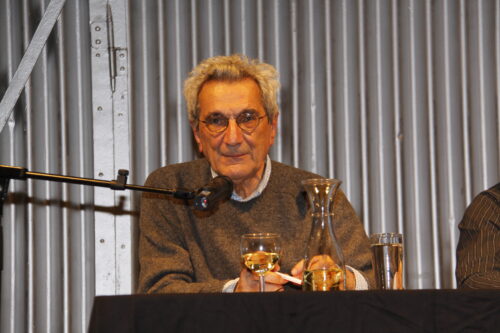
Niklas Luhmann, 1927-1998
Systemic supertheorist of the social
Openly dreaming of eternal life, Gaston Bachelard conceived of paradise as
one huge library with miles of stacks, crammed with books. For Niklas Luhmann,
the great German sociologist and metaphysician who recently died at the age of
70, after a protracted period of sickness, paradise probably looks more like an
endless filing cabinet. He was a one-man theory factory that produced more than
40 books and at least 350 journal articles over forty years. Luhmann explains
his immense productivity with a modest reference to his famous system of
Zettelkasten, file cards with thematic cross-references. He declared that he
actually spent more time arranging and rearranging his system of file cards than
writing books - several at the same time, since when stuck on one he immediately
started another. Yet he is not widely read in English.
The main reason for this remarkable neglect is the sheer difficulty and
complexity of Luhmann's characteristic brand of systems theory. Not that Luhmann
writes jargon (a la Habermas) or long and complicated sentences (a la Bourdieu),
but his theory is pitched at such a high level of abstraction and reflexivity
that it is often hard to see its relevance, even for those who are used to more
metaphysical bedtime reading. Moreover, Luhmann draws on a multiplicity of
transdisciplinary traditions, such as general systems theory (Bertalanffy),
second-order cybernetics (Von Foerster), modular theory of logic (Spencer Brown)
and constructivist theories of knowledge (Maturana and Varela), with which
sociologists and philosophers are usually not well acquainted. Finally,
Luhmann's mode of presentation is non-linear. One can enter the theory by a
multiplicity of conceptual gates - such as complexity, contingency, system,
environment, meaning, communication, self-reference, openness through closure,
and so forth - but as one can never be sure to be on the right track, it is
often tempting to go for the next exit. In this respect, the theory resembles
more a labyrinth than a highway to a happy end.
If Habermas is the leading German philosopher, Luhmann was the leading German
sociologist. Together, they held a joint seminar at the beginning of the 1970s
at the Max Planck Institut in Starnberg. This resulted in a co-authored book,
Theory of Society or Social Technology - What is Achieved by Systems Theory?,
followed by four volumes of commentary on the debate. The title, obviously
chosen by Habermas, suggests that Luhmann's systems theory, which conceptualizes
the public sphere in such a way that legitimation becomes an affair of the
political system itself and thus a form of organized self-legitimation,
represents the most sophisticated expression of the technocratic spirit. In
fact, Luhmann was destined to become a technocrat. He studied law at Freiburg
(1946-49) and worked for several years as a civil servant at the Ministry of
Education and Culture of Lower Saxony (1956-62). In 1960-61 he spent a year at
Harvard University, where he encountered Talcott Parsons. This meeting, together
with his preoccupation with philosophy (Descartes, Kant and especially Husserl)
and early functionalist anthropology (Malinowski and Radcliff-Brown), led
Luhmann into a career as sociologist. His sociology is in fact best understood
as a synthesis of Husserlian transcendental phenomenology and functionalist
systems theory, thus as a kind of cybernetic phenomenology in which the system
takes the place of the transcendental ego - with all the problems of solipsism
which such a systemic reformulation of Husserl entails. Having succesfully
defended a Ph.D. and a Habilitation thesis under the direction of Helmut
Schelsky, Luhmann qualified on the fast track at the University of Munster. In
1969, he became professor in sociology at the newly founded University of
Bielefeld.
If Habermas is the Kant of social theory, Luhmann is its Hegel. `Society',
`communication' and `system' replace `spirit', `substance' and `history'. Like
Hegel, Luhmann wants to bring the present time to its highest conceptual level
and incorporate the entire universe into his system. But unlike Hegel, his last
word is not identity but difference - the `difference of identity and
difference'. Luhmann's social theory is a systemic supertheory of the social.
This theory is universal in that it is a theory of everything, of the world, as
seen and reconstructed from the standpoint of sociology, including a theory of
itself. It is systemic because it uses the guiding difference (Leitdifferenz)
between the system and the environment as its main conceptual tool to analyse
the production and reproduction of the social. Analysing society as a
hypercomplex conglomerate of social subsystems, Luhmann insists that modern
societies are so complex that his own theory of social complexity can offer only
one possible formulation of the social among others.
Luhmann's basic attitude towards the world is one of ironic distance. His
basic vision of the world is one of wonder. Everything that is could in
principle be different, but in practice there is not much that could make a
difference. How this `optimism of the intellect' is countered by a `pessimism of
the will' can be seen in his almost cynical appreciation of the defeat of the
Third Reich. Unlike Habermas, who describes himself without irony as a typical
product of postwar re-education, Luhmann provocatively declares that he
remembers only one thing about the liberation - that American soldiers beat him
up and stole his watch.
At the most abstact level, Luhmann's social theory offers a systemic analysis
of the social ordering of chaos through the reduction of complexity into a
contingent cosmos. This reduction of complexity is effectuated through
communication. Through comunication contingency is reduced. Some possibilities
are realized, others are excluded, and, thanks to communication, the world
becomes relatively predictable. Communications produce communi-cations, and when
those can be linked to each other and structured in a relatively predictable
way, society emerges. Society is made up of communications and nothing but
communications. Elephants, fish and chips or cars do not belong to society. What
is not a communication does not belong to society but to its environment. At
this fateful point, systems theory takes an anti-humanist turn. If society is
made up of communications, people are definitively not. They thus belong to the
environment. And if they belong to the environment, they do not communicate.
Only communications communicate, and given that society is nothing else but the
totality of the communications, people are not only expelled from society, but
they can hardly intervene it in it either. When the distinction between the
environment and the system is reproduced within the system, the system is
`outdifferentiated' (ausdifferenziert) and subsystems emerge that, thanks to
functional specialization and sectorial delimitation of their spheres of
interest and disinterest, are able to further reduce the complexity of the
environment, by specifying which communications belong the system and which do
not (i.e. by selectively attributing each element of the world either to the
system itself or to its environment.)
The system can only communicate about the environment within itself. It
cannot communicate with the environment. Society has no centre and no head.
Representation of the social totality is impossible and so is steering. The
world may be adrift like a ship without moorings, but given that there is and
can no longer be a captain on board to coordinate and steer the operations of
the different subsystems, the rhetorics of anxiety of the critical theorists
only show the superfluity of their normative mode of thought and their
incapacity to come to terms with the hypercomplexity of modern societies. The
functional specialization has increased the rationality of each of the social
subsystems, but only at the price of the irrationality of the global system.
That is the ultimate and demoralising message of `sociological
enlightenment'.
Luhmann literally demoralizes the world. He has given up hope and given away
the normative foundations of social criticism. In exchange, we get romanticism
without Sehnsucht and its methodological complement; irony that shows us again
and again the improbability of the probable, but hardly or never the possibility
of the improbable.
English-speaking readers who are unacquainted with Luhmann's work are
recommended to start with The Differentiation of Society (Columbia U.P, 1982)
and move on to Ecological Communication (Chicago, 1989), which not only presents
the main ideas of Social Systems (Stanford University Press, 1995) in a more
accessible fashion, but, like Risk: A Sociological Theory (De Gruyter, 1993)
also offers a good introduction to Luhmann's diagnosis of modernity.
Observations on Modernity (Stanford University Press, 1988) offers both a
reasonably accessible introduction to Luhmann's late interest in the paradoxical
implications of `second-order cybernetics' and a good sense of his intervention
in the debate on postmodernism.
Frederic Vandenberghe
back |