Shortly after Jean-Luc Godard’s death at the end of 2022, the Parisian Ménagerie de verre, a private art space primarily dedicated to dance, showed excerpts from the late work of the grand master, in a ‘visual and sonorous journey around five films made by Godard between 1999 and 2018’. Planned by his producer Jean-Paul Battaggia […]
Robert Pippin, Filmed Thought: Cinema as Reflective Form (Chicago: University of Chicago Press, 2019). 312pp., £79.00 hb., £28.00 pb., 978 022667 1 956 hb., 978 022667 2 007 pb. The course of the relationship between philosophy and film studies never did run smooth. The encounter of these two disciplines, while producing both influential and exciting […]
If the category ‘late’ has generally served to designate an ever-extending period of Jean-Luc Godard’s filmmaking career – typically dated from his return to cinema at the end of the 1970s when Godard was approaching fifty – with the release of his latest feature, Le Livre d’image: Image et parole [The Image Book: Image and […]
Davidson suggests, rediscovering his orthodoxy, by a working class that is fully conscious of itself and its mission to make a society free of the exploitation that deined the others. The party-form, he weakly insists, is fundamental to its realization. Despite the obvious Hegelian source of such an idealist story, it appears ironically that in […]
REViEWS The cunning of capital explained? Neil Davidson, How Revolutionary Were the Bourgeois Revolutions?, Haymarket Books, Chicago, 2012, xxi + 812 pp., £22.99 pb., 978 1 60846 067 0. In ‘The Notion of Bourgeois Revolution’ (1976) Perry Anderson wrote: ‘Among the concepts traditionally associated with historical materialism, few have been so problematic and contested as that […]
Obituaries Future anterior Chris Marker, 1921–2012 Should we start with the death in Paris, on 29 July 2012, at the age of 91? Or with the birth, on the same day in 1921 in Ulan Bator (or Belleville, or Neuillysur-Seine, depending on who you ask)? We could start, perhaps, with the names, like a proper […]
Isn’t it an affront to Goethe to make a film of Faust, and isn’t there a world of difference between the poem Faust and the film Faust? Yes, certainly. But, again, isn’t there a whole world of difference between a bad film of Faust and a good one? Walter Benjamin, Arcades Project (N1a, 4)Whilst the […]
Media, as considered by media philosophy, are not what you expect them to be. In the first place, they have almost nothing to do with information, or transmission, or communication, or storage. They do not as such produce sense or distribute meanings. If they do so, it is as a side effect or a secondary […]
In the preface to the English edition of Cinema 2, Deleuze claims that cinema is a repetition, in speededup form, of an experience that has already occurred in the history of philosophy. [1] This notion of repetition recalls the biological notion of the ‘recapitulation’ of phylogeny in ontogeny: individual development recapitulates, or replays in speeded-up […]
Commentary From stillness to movement and back Cartoon theory today Esther leslie Just as in recent months caricatures have thrust themselves forcefully into public awareness, in the reaction to Danish newspaper cartoons of Muslim religious icons, their moving cousins, animated cartoons, are likewise more present in the world than ever before.* Cartoons have infiltrated cinema […]
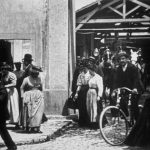
People exposed, people as extras Georges Didi-Huberman The title of the first film shown in history is La Sortie des usines Lumière – in English, ‘Workers Leaving the Lumière Factory’. On 22 March 1895, in the rue de Rennes in Paris, in front of about two hundred spectators, Auguste and Louis Lumière showed for the […]